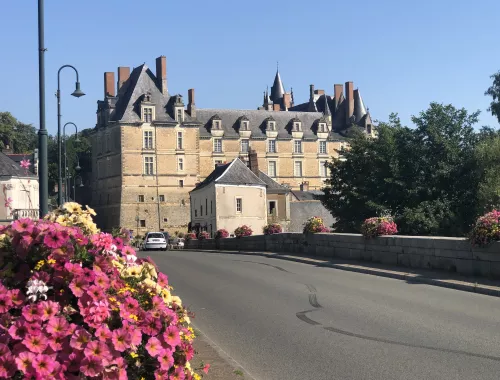
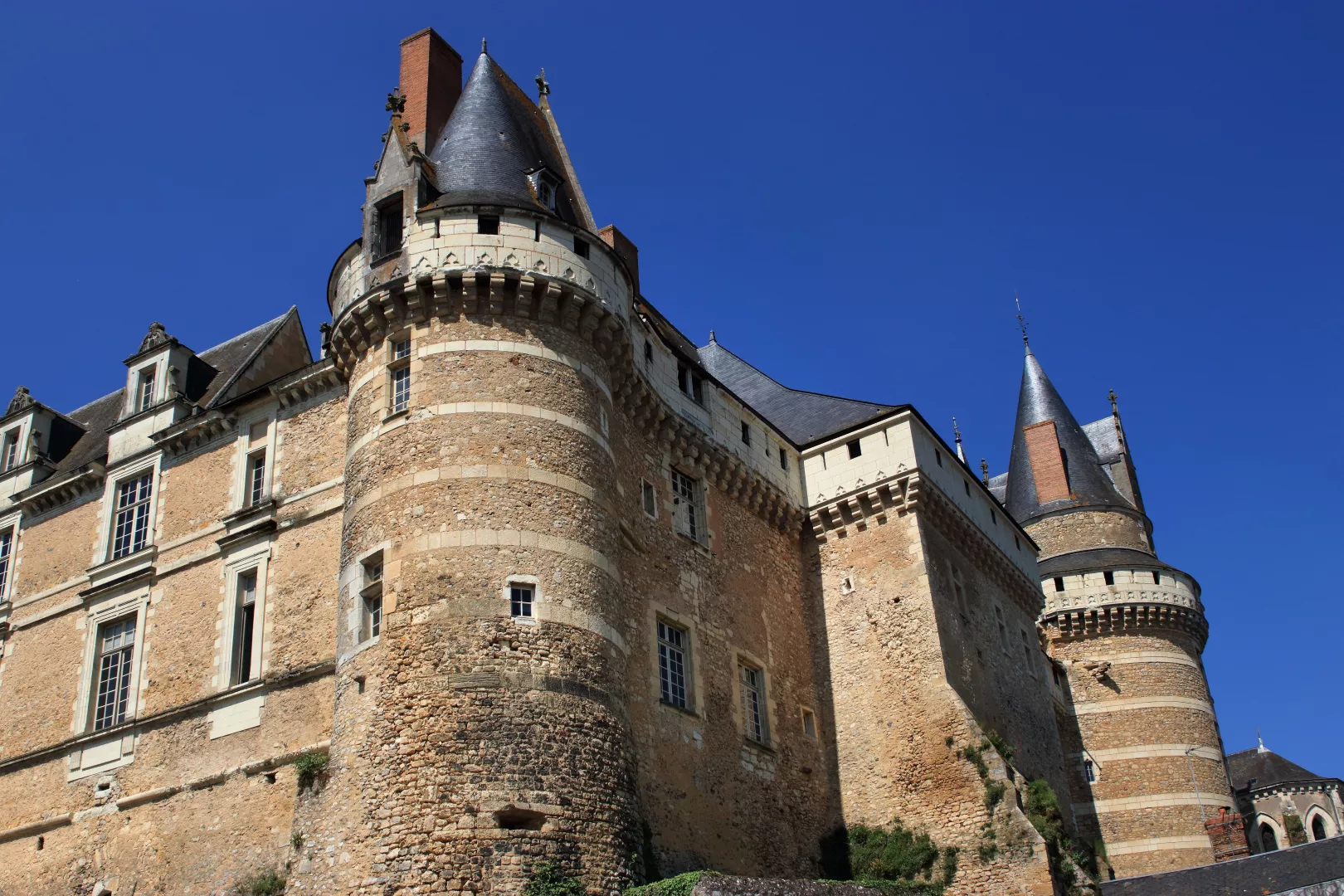
A strategic lock on the Loir Valley, this formidable fortress protected Anjou, a remarkable architectural synthesis of monumental constructions in the Loire Valley in the 15th and 16th centuries.
Private château; guided tours only (duration: 1 hour), open every day except Tuesdays: guided tours at 10.30 am, 11.30 am, 2.30 pm, 3.30 pm, 4.30 pm and 5.30 pm.
Built on a rocky outcrop overlooking the River Loir, this 11th-century structure, commissioned by Foulque Nerra and Geoffroy Martel, was subsequently extended and, over the course of the 15th, 11th and 18th centuries, into this sumptuous palace-fortress where the kings of France loved to stay – a vast building covering 6,000 m² with nearly 100 rooms!
A truly remarkable example of the transition from the Middle Ages to the Renaissance, and a veritable masterclass in architecture, the proud castle of the Counts of Anjou still stands guard over the town of Durtal. History tells us that the St Bartholomew’s Day Massacre is said to have been instigated here.
Following in the footsteps of Henry II, Charles IX, Catherine de’ Medici and Louis XIII, come and discover the splendour of Durtal Castle: its historic kitchens and its 40-metre-long gallery will reveal its paintings, alongside a breathtaking view of Durtal and the Chambiers Forest in the distance. Its rampart walk, its ‘engoulants’ chamber, the ‘Devil’s Room’, the ‘seigneurial quarters’, its 15th-century roof structure – and in the cellars, you’ll also discover the second-largest fireplace in France! So many rooms that are as impressive as they are charming.
This is an opportunity to learn about the history of this castle, which has been listed as a Historic Monument since 1901 and was subsequently donated to the town of Durtal after being plundered during the Revolution. Used as a war hospital until the end of 1945, it subsequently became a care home until 1996, before being bought by private individuals; it has belonged to the Suguenot family since 2007.
The entrance is at the top left of the Place des Terrasses, not on the side facing the church but above the gateway on Rue de la Primaudière, where there is a large black gate. Please wait for the tour to start at the entrance gate.
*There are numerous flights of stairs in the château; there is no lift.
For groups, guided tours are available all year round by appointment.