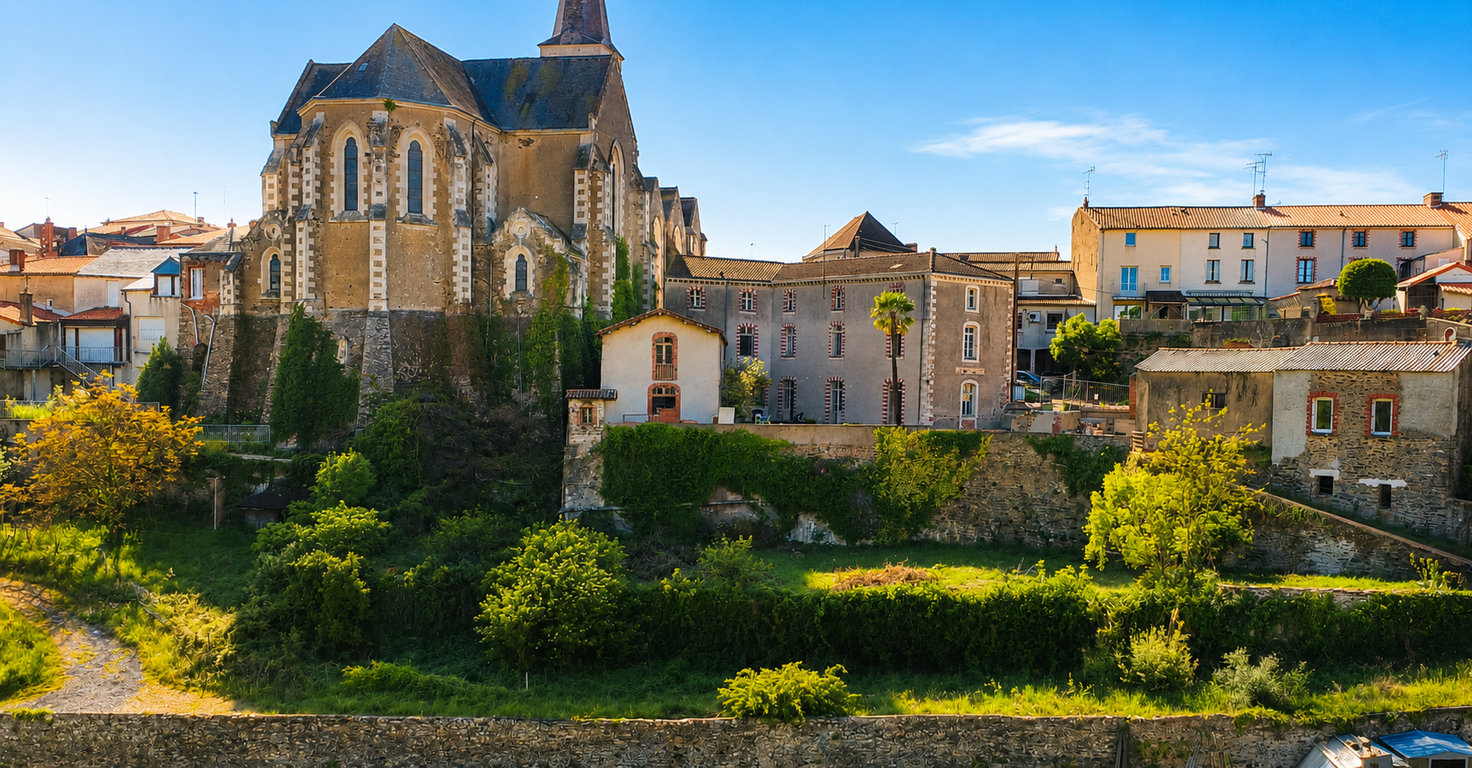
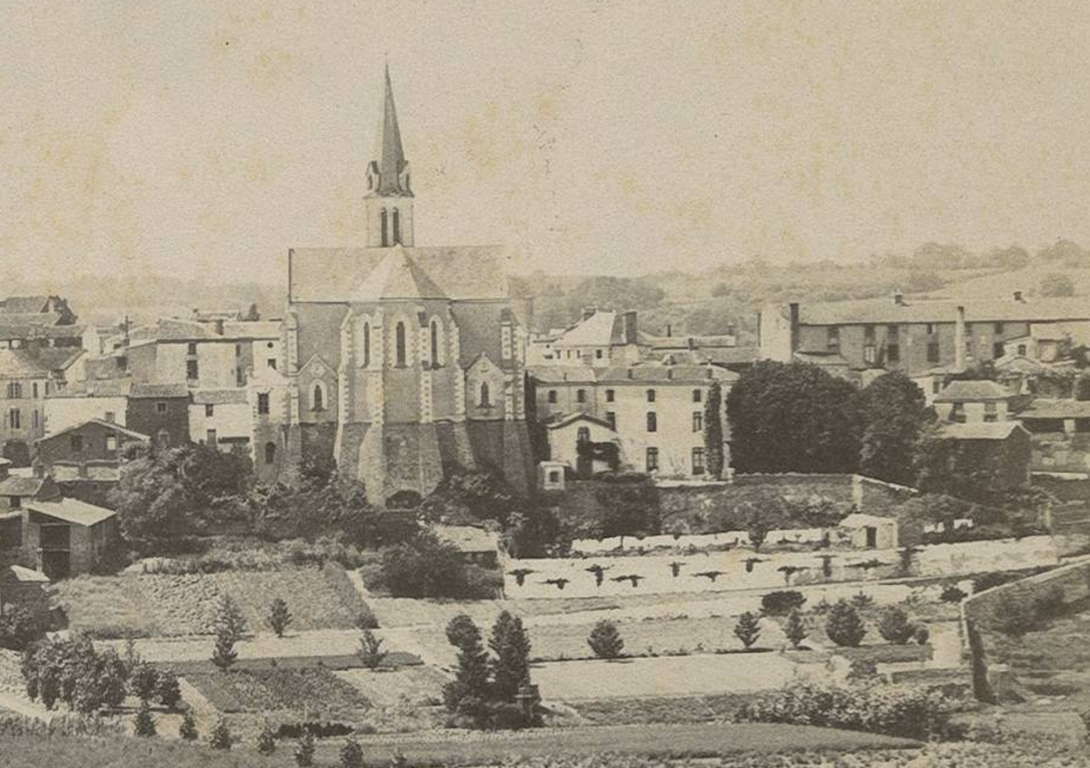
La Chesnay is a remarkable property situated at the chancel end of Montrevault Church. Its history encompasses a variety of uses: fortification, chapel, noble residence and vicarage. The Neo-Renaissance alterations carried out in the 19th century have enabled this house to blend seamlessly into t...
Montrevault Castle was built between the 10th and 11th centuries, surrounded by its fortifications (consisting of stone walls and a natural moat formed by the River Èvre). From this period, a large retaining wall remains, situated between the plot containing the buildings and the main courtyard and the ornamental garden below. This wall, built from local stone quarried from the rock, was naturally altered over the following centuries, but largely retains its thousand-year-old foundation.
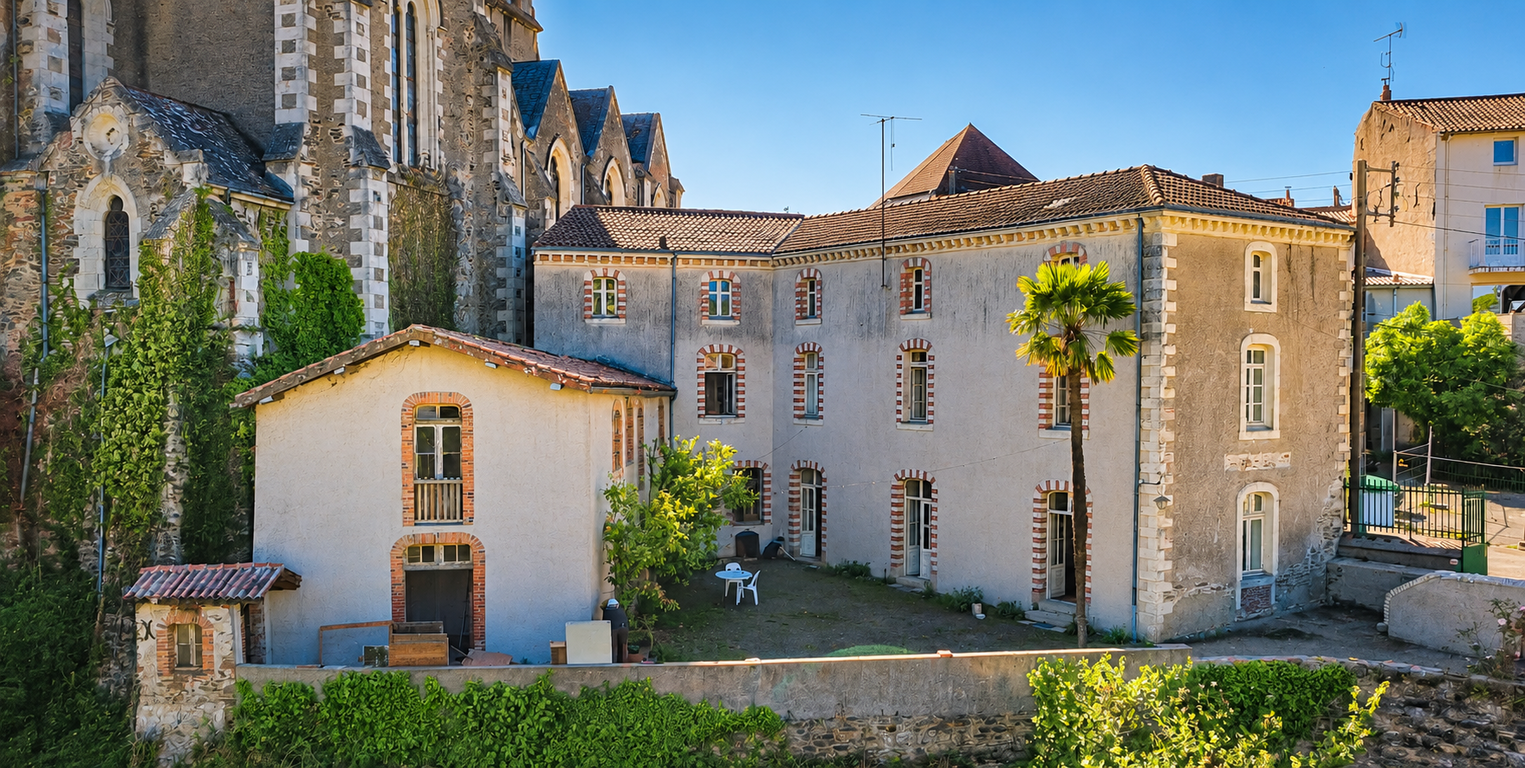
In the 11th century, the castle chapel stood on the site of the current buildings. We can therefore assume, given the age and thickness of the walls, that parts of this chapel remain within the current ‘outbuilding’, which can be seen on the left, adjoining the present-day Church of Notre Dame de Montrevaut.
In the 16th and 17th centuries, a fairly substantial property is identified on the plot; these buildings still exist but were incorporated into the redevelopment carried out in the 19th century.
In the 18th century, the property belonged to the Langevin family. A prominent family in Montrevault, one Langevin was notably the ‘parish priest of Petit and Grand Montrevault’, whilst another was a notary.
In 1761, Anne Langevin – then heiress to the family estate – married Simon Chesnay. The Chesnay family were millers based at the Couroussé mill in La Chapelle-Saint-Florent. The family subsequently enjoyed great prosperity through trade and became owners of numerous properties (they also owned the land of the Château de Bel-Air in La Musse).
Around 1850–60, the property belonged to Julie-Anne Chesnay, wife of Armand Badreau, then bailiff of the Justice of the Peace in Montrevault.
In 1857, the reconstruction of Montrevault church was authorised; the old 16th- and 17th-century church was demolished to make way for a larger and taller building. This work affected the Chesnay family’s property, situated in the immediate vicinity: the garden of the outbuilding disappeared beneath the new church, and the openings in the outbuilding facing the church had to be bricked up. These constraints prompted the Chesnay family to undertake major refurbishment work on all their buildings. Thanks to the skill of the architect and the builders, the old walls were altered throughout to create an Italian Neo-Renaissance style.
The property was then remarkable, featuring window surrounds made of tuffeau stone for the parts visible from the street, and an alternating pattern of tuffeau stone and brick – very much in vogue in Clisson since the early 19th century – for the façades facing the main courtyard. The outbuilding now features window surrounds in orange-coloured brick. The frames are topped with basket-handle arches or, in other cases, with depressed arches. The whole is topped by a cornice with tuffeau modillions, a cornice alternating tuffeau and brick, and a cornice of local bricks.
The layout is as follows:
The ground floor and first floor of the main house contain drawing rooms, a kitchen and the owners’ bedrooms. The second floor accommodates the domestic staff. The lower part of the outbuilding houses the communal service areas: laundry, workshop and wine cellar. The upper floor comprises accommodation for a day labourer’s family.
The estate is fairly complete; it also includes a gazebo (demolished in the 1940s to make way for the garage), a large 25m² greenhouse situated in the lower garden, fountains, an aviary, a large ornamental garden and a kitchen garden.
At the end of the 19th century, Hortense Chesnay (niece of Julie-Anne Chesnay and heiress to the family estate) married Olivier Baron, a chemist from Montrevault, in her second marriage. Mr Baron then ran a chemist’s shop in the outbuilding and took in Julien Rousseau, the future leader of the Montrevault brass band.
In 1918, Hortense Chesnay died childless. The property was then sold off in pieces by her numerous and distant heirs. Fortunately, the pleasure estate—comprising the plot of buildings and the garden situated below—survived this fragmentation. The entire property was purchased by Jean Blavier, son of Paul Blavier (of the Château de La Bellière in Saint-Pierre-Montlimart). The Blaviers then used this house to accommodate the directors and senior staff of their gold mining company.
In 1939, the building stood empty following the departure of the directors to join the war effort. The buildings were initially requisitioned to house refugees from Paris who had fled the capital, which was occupied by the enemy. The Germans in turn requisitioned them to house the Montrevault Kommandantur.
In 1941, the gold mining company, wishing to have the buildings freed from German occupation and no longer having any use for them, agreed to sell them to Augustin Peigné, an industrialist with a keen interest in the presbytery on Rue Mermoz. The sale was concluded in August 1941 on the following terms: Augustin Peigné purchased the property in his own name with a guarantee that it would be donated to the parish in the coming months, thereby enabling him to reclaim the original presbytery for his personal use.
The parish took possession of the premises in October 1941, following various refurbishment works made possible by numerous donations from parishioners.
The priests resided in the manor house as part of their ecclesiastical duties until 2005. The outbuilding, meanwhile, served as a catechism hall and a private school. The last parish priest to occupy the premises was Robert Samson.
By 2025, the estate was in a state of relative disrepair: uninhabited for 20 years, the grounds were overgrown, and the interiors were deteriorating, largely due to poor-quality work carried out between the 1940s and 1980s (incorrectly sized windows, cement render, etc.). The Montrevault town council therefore decided to put it up for sale. The sale was finalised on 12 March 2026.
Since then, the owners have been busy clearing the grounds and restoring all the buildings and gardens. Respect for the history and architecture of this house is paramount: the decorative features that have disappeared over the past few decades are gradually being restored, and the remaining original features are being restored as faithfully as possible.
The main house will once again become a residence. The outbuilding will house a gîte on the first floor, intended primarily for pilgrims and hikers.


 Google ne vérifie pas les avis, mais recherche et supprime les faux contenus lorsqu'ils sont identifiés.